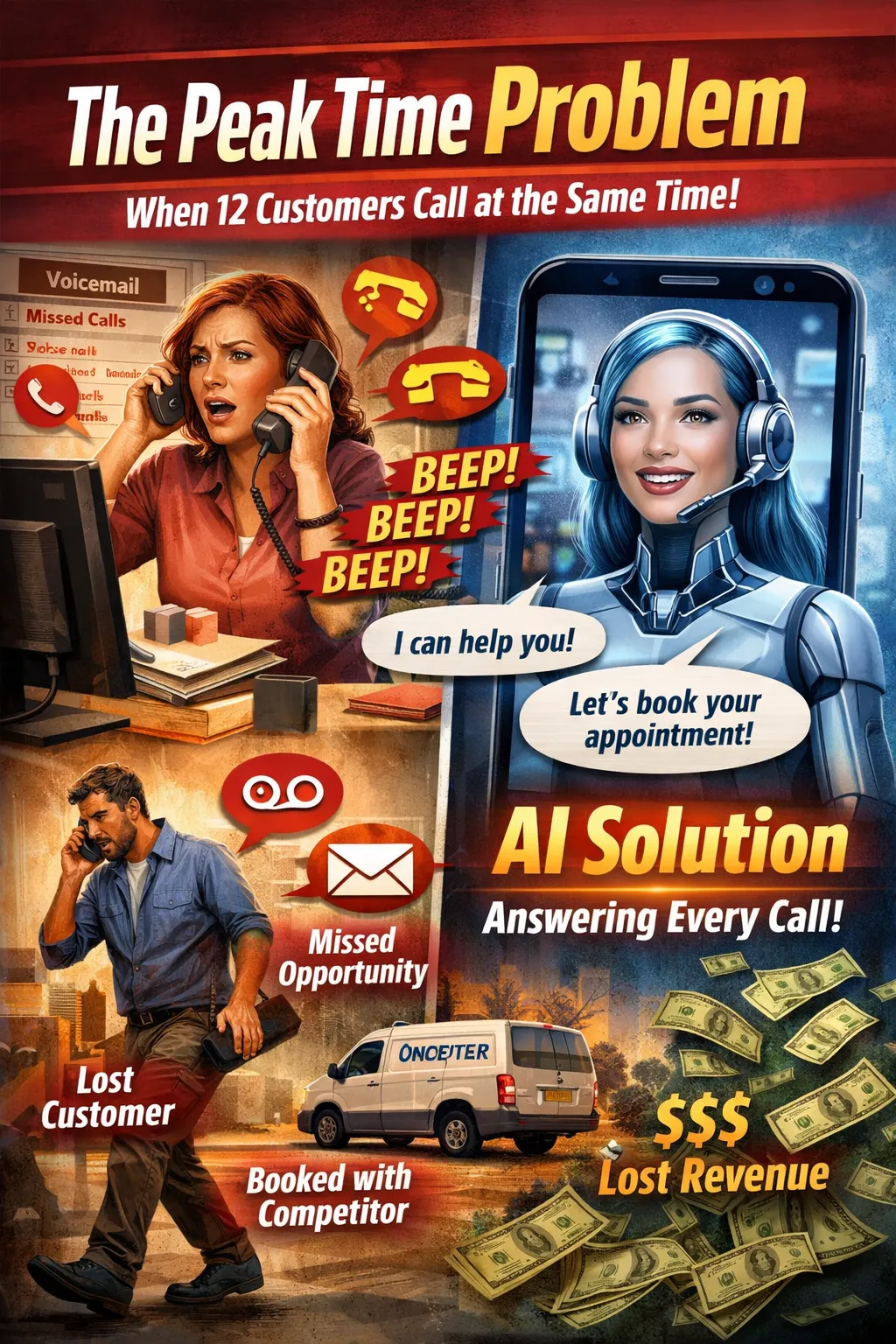
What Happens When 12 Customers Call at the Same Time?
The Peak Time Problem: What Happens When 12 Customers Call at the Same Time?
Picture this: It's Tuesday morning at 10:30. Your phone rings.
You're working at a customer's house, so the call goes to Sarah, your office manager. She answers: "Good morning, this is—" BEEP. Another call comes in.
She tells the first caller to hold on, then answers the second call.
BEEP. BEEP. BEEP.
Three more calls come in at once. Now Sarah is trying to handle five calls with just two hands and one voice.
This is what I call The Peak Time Problem. And it's costing your business thousands of dollars every week.
What Really Happens During the Rush
Here's what happens in those crazy 90 seconds:
Caller 1 is put on hold for three minutes. They get frustrated waiting and hang up. Then they call your competitor down the street.
Caller 2gets answered, but Sarah sounds stressed and rushed. The customer can tell she's distracted. They book an appointment, but they don't feel great about your company.
Callers 3, 4, and 5go straight to voicemail. Studies show that 67% of people who get voicemail won't leave a message. They just call the next business on Google.
You just lost three customers in 90 seconds.
This doesn't just happen once. It happens several times every week during your busiest hours. For most businesses, that's 8-10 AM (when people are planning their day) and 4-6 PM (when they're thinking about what needs to get done at home).
Let's do some simple math. If you miss just 10 calls per week because you're too busy, and each job is worth $500, that's $5,000 lost every week . Over a year, that's $260,000 walking away from your business.
The "Solutions" Most Businesses Try (And Why They Fail)
Most business owners know this is a problem. Here's what they usually try:
Solution 1: Hire Another Person to Answer Phones
This makes sense at first. If one person can't handle all the calls, hire two people.
But here's the problem: you're only super busy for 2-3 hours each day. The rest of the time, one person could handle the calls just fine. So you're paying two people's salaries ($70,000-$90,000 per year total) for work that's only needed part-time.
Plus, if six people call at the exact same time, you still have the same problem.
Solution 2: Use an Answering Service
Answering services cost $300-$800 per month. That seems cheaper than hiring someone.
But they have big problems:
✅ They take messages but can't book appointments (they don't have your calendar)
✅ They can't answer questions about your specific services or prices
✅ Customers can tell they're talking to a call center, not your actual business
Most customers don't like this. Many will hang up and call someone else who answers their own phone.
Solution 3: Just Let Calls Go to Voicemail
This is free, so lots of businesses do this. But remember: 60-70% of people who get voicemail never call back. While you're listening to voicemails later, your competitors are already booking those customers.
The Solution That Actually Works
What if you could answer unlimited calls at the same time? Not by hiring 10 people, but by using AI?
An AI phone system can:
✅ Answer 50 calls at the exact same time
✅ Talk to each caller like they're the only one calling
✅ Book appointments right into your calendar
✅ Answer questions about your services and prices
✅ Never put anyone on hold
✅ Never sound rushed or stressed
This isn't science fiction. Real businesses are using this right now.
Service businesses that add AI phone systems typically see these results in the first 30 days:
✅ 2-3x more calls answered during peak times
✅ 40-60% more appointments booked
✅ Zero calls going to voicemail
✅ Less stressed employees
✅ Thousands in additional revenue
24/7 coverage so you never miss a call. (Even at 2 AM)
The AI doesn't replace your team. It handles the overflow calls so your real employees can focus on complicated customer problems and building relationships.
What This Means for You
Every time your phone rings when you're busy, you're taking a risk.
Will the customer wait? Will they hang up? Will they call your competitor instead?
With an AI system helping your team:
✅ Every call gets answered right away, even when you're slammed
✅ Every caller gets your full attention
✅ You don't lose customers to voicemail anymore
✅ Your employees can focus on the important stuff that needs a human touch
The peak time problem isn't just about missing calls. It's about losing money, frustrating customers, stressing out your employees, and watching competitors steal your business.
The Bottom Line
Most service businesses make back 3-5 times what they spend on AI systems in the first 90 days. Why? Because they finally answer all those calls they were missing before.
Think about your busiest day last week. How many calls did you miss? How many customers got a rushed conversation? This happens every single week.
The real question is: how much money are you losing by not fixing this problem?
The solution exists. Your competitors might already be using it. What are you waiting for?